MARINE FOSSIL DEPOSITS WORLDWIDE · NATURE
Crinoid stem-columnal study
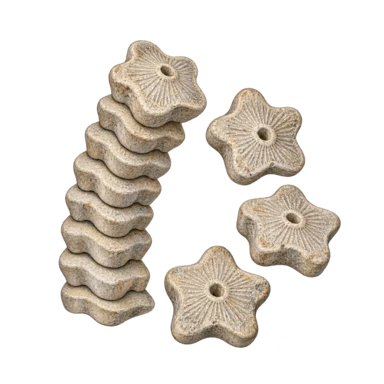
What it means: BGS records that crinoid stem columnals have been called “fairy money” in parts of England; it also describes the name St Cuthbert’s beads in a particular saint’s legend.
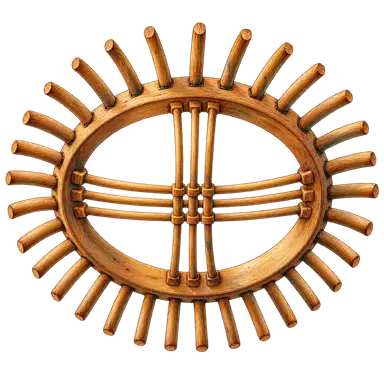
Many crinoid stems consist of stacked calcitic plates called columnals. Their outlines vary, and some have star-like forms. BGS records that crinoid stem columnals have been called “fairy money” in parts of England; it also describes the name St Cuthbert’s beads in a particular saint’s legend.
A short stack of patterned plates can be a trace of a marine animal. The motif offers an editorial language for fragments that still carry a meaningful whole.
Often chosen for: Family, home & belonging · Friendship & connection
Respectful use: Crinoids are animals, not plants. Do not universalize English fossil folklore or imply all crinoids possess stems. Crinoids are marine echinoderm animals, not plants; not all crinoids have stems. No genus, fossil locality or exact specimen is identified. The attributed English folklore is bounded context, not universal symbolism or a protective promise. This is an original generated decorative study, not exact specimen, map, route or technical documentation. Blue and gold are editorial colors. Any personal reflection is contemporary interpretation; only explicitly bounded cultural context is documented. No blanket commercial or manufacturing clearance is claimed.
Sources: [1] bgs.ac.uk