INTAGLIO PRINTMAKING; BOUNDED EUROPEAN MUSEUM-HISTORY CONTEXT · OBJECTS
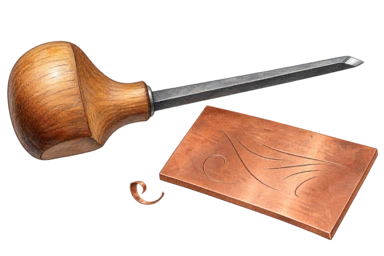
Engraver’s burin and incised-plate study
What it means: The Met explains the steel cutting end and palm handle. Getty’s discussion emphasizes tools adjusted to an engraver’s hand and practice. The motif represents a working tool and an original, otherwise blank plate, rather than a copied print.
A burin cuts recessed lines into a metal plate. Ink retained in those cuts can be transferred to paper under pressure. The V&A connects European engraving on paper in the fifteenth century with earlier metal-decorating work.
Give the next line your attention.
Often chosen for: Love & partnership
Respectful use: This is an original unbranded tool-and-plate study, not a copied historical print, museum accession or instructional cutting demonstration. The Library of Congress wood-engraving burin supplies family silhouette evidence only; metal-plate use is supported separately by Met and Getty sources. The burin must be distinguished from acid etching and relief wood engraving. The plain materials and incised curves are contemporary choices. No maker marks, monogram, heraldry, religious composition or contemporary engraver’s design is reproduced. Shallow grooves remain within opaque copper. No exact cutting angle, alloy, dimensions, operating safety or manufacturing accuracy is asserted; source-image and target-market review remain open. This is original generated decorative artwork, not an exact site survey, artifact replica or operating guide. Blue and gold are editorial colors. No institutional or community endorsement is claimed. No blanket commercial or manufacturing clearance is claimed.
Sources: [1] vam.ac.uk [2] metmuseum.org [3] getty.edu [4] loc.gov