EUROPE AND ADJACENT REGIONS; CULTIVATED ELSEWHERE · NATURE
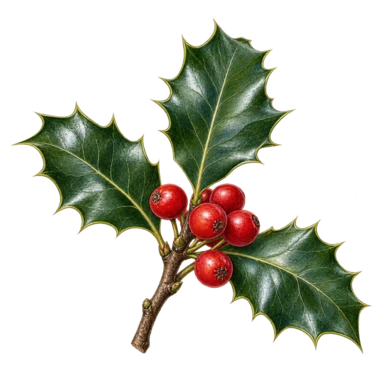
Holly fruit-and-leaf sprig study
What it means: Kew records holly's association with Christmas in Britain and many other western cultures. This is a bounded seasonal use, not a universal meaning of winter.
Common holly is evergreen, with glossy leaves that can have wavy spiny margins and clustered red fruits. The fruits are botanically drupes; this selected fruiting sprig does not imply that every holly plant bears fruit. Kew records holly's association with Christmas in Britain and many other western cultures. This is a bounded seasonal use, not a universal meaning of winter.
Glossy leaves and a small red fruit cluster hold their brightness together. This original sprig can carry a seasonal message of welcome and continuity.
Often chosen for: Family, home & belonging · Luck, joy & celebration
Respectful use: Christmas use is culturally specific, not universal winter symbolism. No Druidic origin claim, protective efficacy, or edibility is asserted; the source’s historical folklore is not botanical fact. Higher growth can have less-spiny leaves. Red fruit and green foliage describe the natural-color edition; blue and gold are ornamental. No older folklore-origin, protective, medicinal or food-safety claim is made. This is an original generated decorative study, not exact specimen, map, route or technical documentation. Blue and gold are editorial colors. Any personal reflection is contemporary interpretation; only explicitly bounded cultural context is documented. No blanket commercial or manufacturing clearance is claimed.
Sources: [1] powo.science.kew.org