TEMPERATE ASIA; JAPANESE LITERARY AND ARTISTIC CONTEXT · NATURE
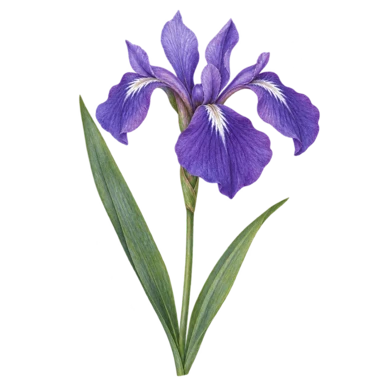
Kakitsubata water-iris study
What it means: Nezu Museum explains a Tales of Ise episode in which a traveler sees kakitsubata at Yatsuhashi, remembers his wife in Kyoto and composes a poem. This is a particular literary association with affection across distance.
Iris laevigata has sword-shaped leaves and broad falls with narrow pale basal markings. This wetland-flower study shows three broad falls, smaller overlapping upright floral parts and two leaves; purple describes the natural-color edition. Nezu Museum explains a Tales of Ise episode in which a traveler sees kakitsubata at Yatsuhashi, remembers his wife in Kyoto and composes a poem. This is a particular literary association with affection across distance.
A waterside flower can make a distant place feel close. This new iris study invites an editorial reflection on memory and affection across distance.
Often chosen for: Care, gratitude & remembrance
Respectful use: The flower is Iris laevigata-informed rather than a diagnostic specimen. Kakitsubata is not a label for every Japanese iris; shōbu can refer to a different plant, including Acorus. No festival custom is transferred between plants. The original composition contains no bridge, gold screen or heraldic fleur-de-lis. It does not reproduce Kōrin’s arrangement or quote a modern poem translation. This is an original generated decorative study, not exact specimen, map, route or technical documentation. Blue and gold are editorial colors. Any personal reflection is contemporary interpretation; only explicitly bounded cultural context is documented. No blanket commercial or manufacturing clearance is claimed.
Sources: [1] rhs.org.uk [2] nezu-muse.or.jp