LONDON, ENGLAND; NINETEENTH-CENTURY OPTICAL DRAWING INSTRUMENT · OBJECTS
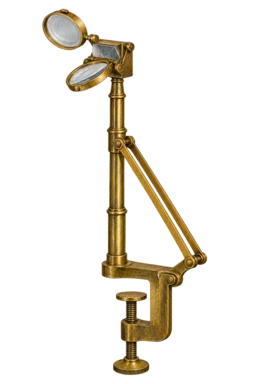
Camera lucida prism drawing aid
What it means: National Trust records the selected brass-and-glass example as NT 1525276, made in London during 1830–1850. The instrument connects close observation with drawing. Oxford’s circa-1820 camera lucida explains the optical principle; the Science Museum’s later cased example is a separate object with its own provenance.
A camera lucida brings a virtual view of the subject together with the drawing surface through an optical arrangement. This whole-instrument study keeps the prism head, hinged lenses, extending shaft, paired braces and complete clamp visible.
Look closely before making your mark.
Often chosen for: Care, gratitude & remembrance · Curiosity, creativity & wonder
Respectful use: This is an original source-informed, unmounted instrument study. The temporary museum support block is omitted; the full instrument clamp, captive screw and both braces remain. No drawing board, pencil, physically projected image or hidden component is invented. The historical specimen’s date and dimensions do not establish its photographs’ dates or a calibrated replica. Fine maker marks and scales are omitted, and no optical operation, accuracy, navigation use or performance is promised. The National Trust photographs carry their own credits and no verified open photograph licence; the separate Science Museum image, data and text licences do not license National Trust images. All references remain inspection-only. No institutional endorsement, photograph reuse, legal or manufacturing permission is inferred. Original generated decorative artwork, without a replica, verified functional result or institutional-endorsement claim. Blue and gold are editorial colors. No blanket commercial or manufacturing clearance is claimed. Legal and community review remain separate.
Sources: [1] nationaltrustcollections.org.uk [2] mhs.ox.ac.uk [3] collection.sciencemuseumgroup.org.uk