SOLAR SYSTEM · NATURE
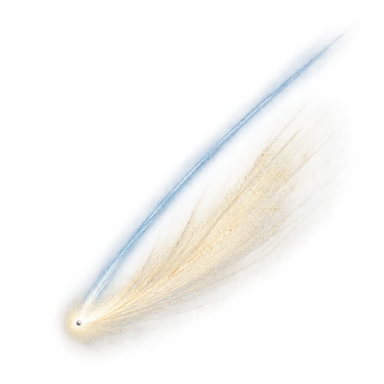
Comet two-tail study
What it means: Modern editorial interpretation: An editorial expression of a journey becoming briefly visible.
A comet near the Sun can develop a coma and two different tails: a broad, curved dust tail and a relatively straight ion tail directed away from the Sun.
A small icy body can grow an immense visible presence near the Sun. Its two tails offer a modern image of motion and the many traces one journey can leave.
Often chosen for: New beginnings & hope
Respectful use: Do not call the tail smoke or suggest it always trails directly behind orbital motion. No fortune, catastrophe, or ancient omen claims. No named comet, orbital-motion direction or universal omen tradition is identified. Pale dust and blue ion tones are illustrative; blue/gold is an editorial palette. This is an original generated decorative study, not exact specimen, map, route or technical documentation. Blue and gold are editorial colors. Any personal reflection is contemporary interpretation; only explicitly bounded cultural context is documented. No blanket commercial or manufacturing clearance is claimed.
Sources: [1] science.nasa.gov [2] science.nasa.gov [3] spaceplace.nasa.gov