
AMSTERDAM DEVELOPMENT AND PARIS INSTRUMENT-MAKING CONTEXT · OBJECTS
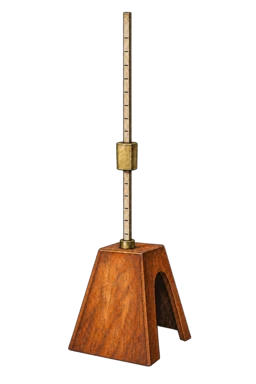
Early exposed-rod metronome study
What it means: This instrument belongs to the history of measured musical practice and shared mechanical development. The illustrated setting does not establish a beat rate, therapeutic effect or a single correct pace for creativity.
Smithsonian records Dietrich Winkel demonstrating a mechanical metronome in Amsterdam in 1814 and Johann Maelzel subsequently adding a scale and manufacturing instruments. The Met preserves a Paris example dated about 1821, with an exposed weighted rod above a low wooden base. The shared development story belongs to the historical context; this original plain study is about measured musical practice.
A modern invitation to find a steady pace for practice.
Often chosen for: Peace, calm & comfort
Respectful use: The exposed-rod configuration is informed by Met accession 1979.1.2, dated about 1821 in Paris. Its source photograph is undated and monochrome: wood/brass colors are contemporary material-led choices. The Smithsonian history concerns a distinct later accession and supplies bounded development context, not a second view of the Met object. The low pedestal, connected rod and weight remain visible; there is no reconstructed internal escapement or enclosing modern pyramid. Maker plaque, lettering and calibrated beat markings are omitted. No exact tempo, medical entrainment, universal rhythm meaning, institutional endorsement or working-product promise. Source-image, commercial and manufacturing review remain separate. This is original generated decorative artwork, not an exact artifact replica, site survey or operating guide. Blue and gold are editorial colors. No institutional or community endorsement is claimed. No blanket commercial or manufacturing clearance is claimed.