PRECISION MARINE TIMEKEEPING, WITH A BRITISH HISTORICAL REFERENCE AND SUBSEQUENT INTERNATIONAL USE · OBJECTS
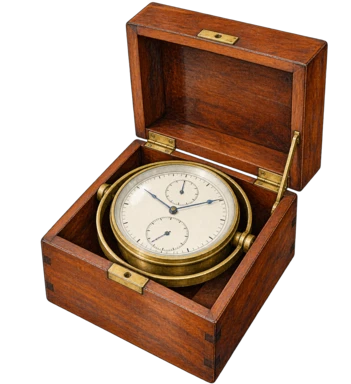
Gimballed marine-chronometer study
What it means: A precision instrument supporting navigation through time comparison; no promise that gimbals alone guarantee accuracy.
Navigators could use a reliable reference clock alongside local observations to determine longitude. Royal Museums Greenwich documents a long development from early sea clocks through Harrison, Arnold and Earnshaw, rather than one isolated invention. Its circa-1900 chronometer 4824 supplies the visible case-and-gimbal relationship for this original, unbranded type study.
I can keep a steady rhythm through change.
Often chosen for: Love & partnership · Peace, calm & comfort
Respectful use: This is an original external type study informed by a circa-1900 museum object, not a replica of that accession or a Harrison clock. The visible bezel, clock bowl, support ring and pivot relationships do not establish concealed mechanisms or a universal ring count. Maker names, serials, copied dial decoration and hidden movement are omitted. Gimbals alone do not guarantee precision; no calibration, seaworthiness, navigation instruction or working-device promise is provided. Museum photographs are inspection-only, and historical age does not establish general source-image or product-design permission. This is original generated decorative artwork, not an exact site survey, artifact replica or operating guide. Blue and gold are editorial colors. No institutional or community endorsement is claimed. No blanket commercial or manufacturing clearance is claimed.
Sources: [1] rmg.co.uk [2] rmg.co.uk [3] rmg.co.uk