HISTORICAL LACE-MAKING TOOL AND DOCUMENTED TEXTILE COLLECTIONS · OBJECTS
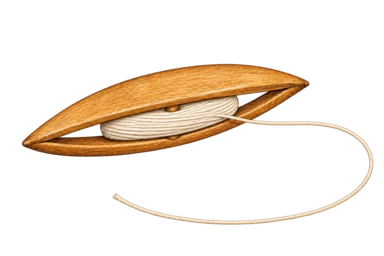
Plain wooden tatting shuttle
What it means: The historical manual supports plain wooden shuttle construction. The additional Guild collection description locates winding on a central block, but its specimen material and provenance are not transferred to this new wooden study. No definitive national origin, invention or sailor-origin story is asserted.
Tatting forms lace from knots and loops using a small shuttle. Historical instructions describe two close-ended surfaces joined by a crosspiece, with thread wound between them. This study shows the tool and loose thread, without a knot pattern.
A modern reflection on patience in small, repeated acts of making.
Often chosen for: Peace, calm & comfort
Respectful use: The two-shell construction is source-informed by Beeton’s historical manual, while the illustrated loose thread is an editorial unfinished curve. It is not a verified knot sequence, lace pattern, manufacturing plan or copied sampler. The Guild winding evidence is used only for topology; no bone, ivory, tortoiseshell or other restricted-material recommendation is made. The new plain wood and cotton do not claim the material, date or provenance of the Smithsonian specimen. Direct Smithsonian access varied, so the archived official record and inspected specimen image remain the bounded evidence; Reading’s lace samples are not construction proof. No current designer pattern, maker ornament, traditional emotion or commercial/photo-use clearance is supplied. Original generated decorative artwork, without a replica, working-instrument or institutional-endorsement claim. Blue and gold are editorial colors. No blanket commercial or manufacturing clearance is claimed. Legal and community review remain separate.
Sources: [1] trc-leiden.nl [2] antiquepatternlibrary.org [3] embroiderersguildvic.org [4] si.edu