HOUSEHOLD MILLING; SCOTTISH MUSEUM EVIDENCE AND WIDER USE · OBJECTS
Rotary hand-quern study
What it means: The named Scottish finds ground the story in everyday food preparation. Museum of Cambridge describes regional forms and use beyond Britain; this is neither a uniquely Scottish invention claim nor a claim that one grain or household practice was universal.
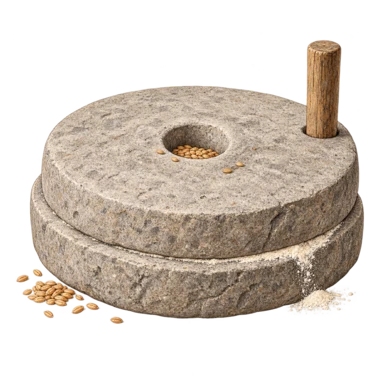
Cromarty Courthouse Museum preserves a late-medieval quern stone recovered in community excavations. Its interpretation describes the upper stone turning above a stationary lower one to grind household grain. Museum of Banff evidence distinguishes the central opening from an off-centre handle socket. This new drawing studies a complete plain two-stone mechanism, rather than reproducing an excavated fragment. The named Scottish finds ground the story in everyday food preparation. Museum of Cambridge describes regional forms and use beyond Britain; this is neither a uniquely Scottish invention claim nor a claim that one grain or household practice was universal.
A modern reminder that small daily turns can sustain a great deal.
Often chosen for: Peace, calm & comfort · Care, gratitude & remembrance
Respectful use: No universal prosperity or sacred meaning and no romantic claim that domestic work was effortless. The source photograph of a damaged stone is inspection-only; no exact excavated-object replica or manufacturing/food-safety assurance is claimed. The NMS page exposed only a loading shell in this recheck, so its specimen claim is not needed for the new story. This is an original generated decorative study, not an exact map, site survey, historical artifact replica or operating guide. Blue and gold are editorial colors. No institutional or community endorsement is claimed. No blanket commercial or manufacturing clearance is claimed.
Sources: [1] museumofthehighlands.org [2] bphsmob.org.uk [3] museumofcambridge.org.uk