YAZD, IRAN · ARCHITECTURE
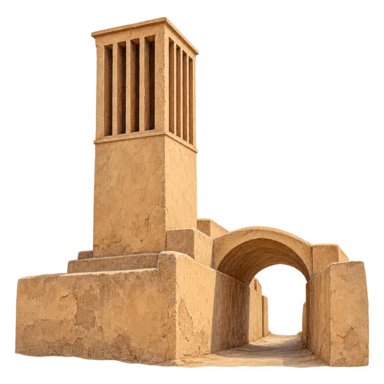
Yazd windcatcher and sabat study
What it means: Yazd remains an inhabited city. The conservation account concerns everyday architectural knowledge and ongoing care for earthen buildings. Qanats supply water underground and are distinct from windcatcher ventilation; neither system is reduced to a decorative emblem or a claim that all buildings work identically.
Yazd’s earthen urban fabric responds to an arid climate through thick walls, covered alleys, courtyards and windcatchers. UNESCO describes the partly covered alleys, or sabats, as sheltered routes, while windcatchers help regulate conditions inside buildings. This study joins two documented components in an original arrangement rather than reconstructing one address. Yazd remains an inhabited city. The conservation account concerns everyday architectural knowledge and ongoing care for earthen buildings. Qanats supply water underground and are distinct from windcatcher ventilation; neither system is reduced to a decorative emblem or a claim that all buildings work identically.
A modern reflection on resourcefulness and making room for shelter.
Often chosen for: Family, home & belonging · Strength & courage · Care, gratitude & remembrance
Respectful use: No private home, sacred building or identity-bearing ornament is reproduced. Source photographs are inspection-only; the composition is a declared component synthesis, not an exact street reconstruction. Retain the original record’s asset/market review and name-review limits; no heritage, tourism, access, commercial-product or community authorization is claimed. This is an original generated decorative study, not an exact map, site survey, historical artifact replica or operating guide. Blue and gold are editorial colors. No institutional or community endorsement is claimed. No blanket commercial or manufacturing clearance is claimed.
Sources: [1] whc.unesco.org [2] craterre.org