GENERALIZED WOODY BAMBOO ANATOMY; CHINESE ART CONTEXT IDENTIFIED SEPARATELY · NATURE
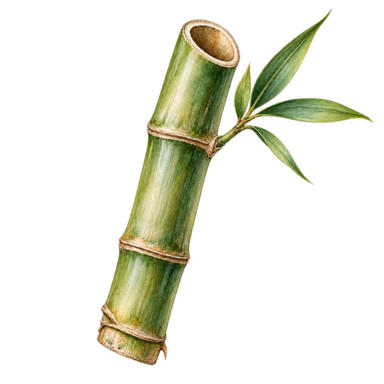
Bamboo node-and-internode study
What it means: The Metropolitan Museum notes that bamboo can represent a virtuous person enduring difficult times in Chinese art. This describes an artistic association rather than a universal property of the plant.
Woody bamboo culms are segmented by nodes and internodes. Internodes are commonly hollow while transverse partitions occur at nodes; some bamboos have solid or very narrow interiors, so this selected open-internode form is not universal. The Metropolitan Museum notes that bamboo can represent a virtuous person enduring difficult times in Chinese art. This describes an artistic association rather than a universal property of the plant.
A sequence of nodes offers a modern reflection on steady growth and adaptability. This personal reading does not promise physical invulnerability or prescribe how someone should endure hardship.
Often chosen for: Peace, calm & comfort · Strength & courage
Respectful use: Generic morphology is not a species identification. Bamboo can break; do not convert an artistic metaphor into an absolute mechanical claim. No cultural-community endorsement is implied. The open end passes through an internode; it does not establish a continuous empty pipe through every node. This generalized study is not species-diagnostic, a harvesting guide or a construction model. Bamboo can break, and neither cultural association nor editorial meaning is a mechanical performance guarantee. This is an original generated decorative study, not exact specimen, map, route or technical documentation. Blue and gold are editorial colors. Any personal reflection is contemporary interpretation; only explicitly bounded cultural context is documented. No blanket commercial or manufacturing clearance is claimed.
Sources: [1] cgspace.cgiar.org [2] metmuseum.org