SEVENTEENTH-CENTURY ENGLISH INSTRUMENT TYPE IN ROYAL MUSEUMS GREENWICH · OBJECTS
Boxwood nocturnal star clock
What it means: Greenwich connects nocturnals with both skilled observation and printed learning aids, including Peter Apian’s 1524 description. The specific boxwood example is English and seventeenth-century, with an unknown maker; this does not establish a single inventor or universal symbolism.
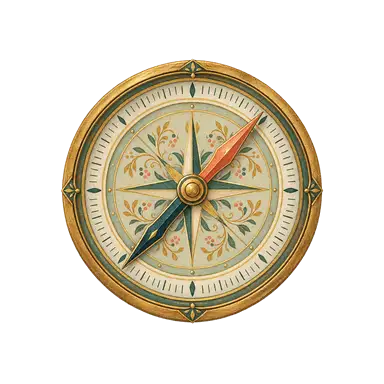
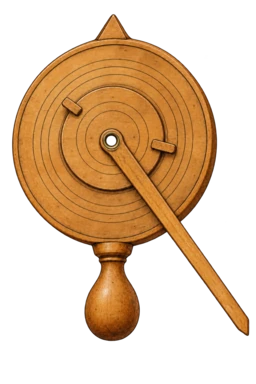
A nocturnal relates the apparent movement of northern circumpolar stars to a date-and-hour scale. Royal Museums Greenwich preserves a boxwood example with a central sight hole, a rotating disc and a long pointer. Its two short pointers allow use with different stellar reference groups.
A modern reflection on finding orientation through patient observation.
Often chosen for: New beginnings & hope · Strength & courage
Respectful use: This original decorative study is informed by RMG AST0128, with a smooth solid rim, central sight hole, two short tabs and a separate long pointer. Its plain rounded grip is an explicit contemporary simplification of the documented ornate grip; no exact replica is claimed. No maker inscription, numbered calibration, rear scale, compass rose or astrolabe openwork is copied. The seventeenth-century object date is separate from the undated source photographs. Stellar observation depends on location, date and conditions; this image supplies no latitude-independent, cloudy-sky, night-travel or safety-use guidance. Hope and orientation are modern editorial readings. Source photographs remain inspection-only, and their reuse, commercial and manufacturing permissions are unresolved. Original generated decorative artwork, without a replica, working-instrument or institutional-endorsement claim. Blue and gold are editorial colors. No blanket commercial or manufacturing clearance is claimed. Legal and community review remain separate.
Sources: [1] rmg.co.uk [2] rmg.co.uk